AI Commerce Readiness Intelligence
AI agents are already recommending products — from stores with the right signals in place. ACRI audits the five layers that determine whether you're visible to them, and generates everything needed to get there.
How people find products has shifted. AI agents don't browse your site the way a human does — they query structured data, read machine-readable feeds, and cross-check signals across sources. If your store doesn't speak their language, you simply don't appear, and you won't know why.
AI agents cross-check sources. Mismatched prices, missing GTINs, JS-rendered product data, or schema that doesn't match the page all trigger silent exclusion — no error, no notification, you just don't appear. ACRI scores every layer.
llms.txt tells AI systems what your store sells and how to access your catalog. The UCP manifest (/.well-known/ucp) declares your capabilities to agent protocols — the signals that tell agents you exist and are ready to be queried.
Schema.org JSON-LD on every product page. Plugins get you started, but agent-readiness needs the fields most stores miss: weight, dimensions, material, color, size, MerchantReturnPolicy, OfferShippingDetails, and full variant attributes. Inconsistent data here causes silent exclusion.
A dedicated JSON endpoint exposing your full catalog, separate from on-page schema. It's what llms.txt points to as the source of truth, and it powers Google Merchant Center, ChatGPT product feeds, and UCP catalog discovery.
Product data in server-rendered HTML, not JS-injected — agents can't run JavaScript. Fast API responses (under 200ms), stable URLs, consistent SKUs, real-time inventory sync, and policy pages as structured data.
A clean WooCommerce REST API with a read-only service account, a product search endpoint returning structured results, optional GraphQL, and webhooks for inventory and orders — the layer that enables agent-initiated transactions when protocols mature.
Not "improve your schema" — the actual files, feeds, and manifests, generated and validated.
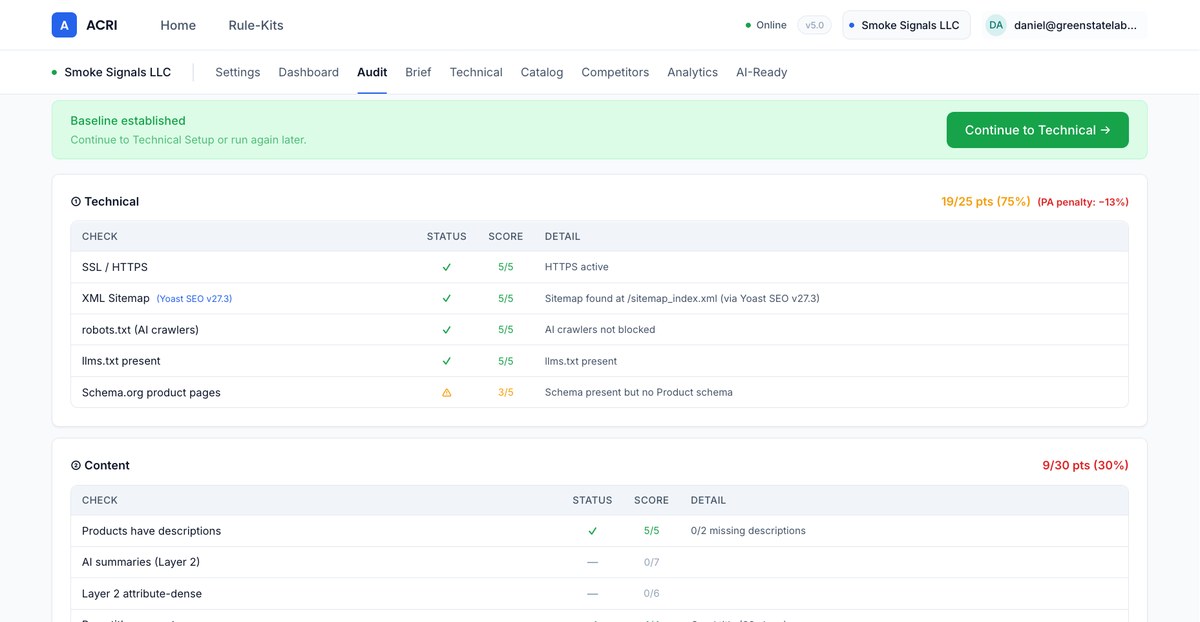
Crawls and scores your store across all five layers — 43+ checks on a 10-point scale. Every finding is specific: which products, which fields, in what priority order.
Generates and injects Product, Offer, MerchantReturnPolicy, OfferShippingDetails, Organization, and BreadcrumbList markup — validated against Google's Rich Results test.
A versioned JSON catalog endpoint — the source of truth for AI agents, GMC, and UCP — plus catalog.json and taxonomy.json for downstream integrations.
Creates and maintains your /llms.txt — store description, categories, policy pages, and the catalog endpoint. Updated automatically as your catalog changes.
Publishes a /.well-known/ucp manifest declaring capabilities, categories, payment methods, and compliance metadata for UCP-compatible agents.
Crawls up to five competitors, runs the same five-layer audit, and returns a side-by-side comparison of where you lead and where you're behind.
Generates your IndexNow key and submits URLs to Bing, Yandex, and others for instant indexing — no waiting for the next crawl cycle.
Dimension-by-dimension scoring and a prioritised fix list ordered by discovery impact — a specific implementation plan, not a summary of problems.


ACRI audit scores push directly into the WooCommand dashboard — your five-layer readiness score, schema status, llms.txt status, and top priority fixes alongside your store operations data. Available together or independently; if you run WooCommerce and want both, they're built as a pair.